Tuesday, April 21, 2009

My Homemade Meat Smoker Part Deux


In response to some interest over the smoker, here's a picture of the resulting pork tenderloin (you can click on the image for a larger, more mouth-watering version - my wife took the picture). I marinated it overnight, then put a simple rub on it (black pepper, salt, cayenne pepper & onion powder) and rolled it in crushed cashews. Unfortunately there was a little too much cayenne pepper in the rub and it overpowered the marinade and the cashews too (you could still taste the cashews just a little once you got used to the spiciness). It was still delicious, just spicy and delicious. God is indeed very good.

And it's no use asking for leftovers: There aren't any.

Saturday, April 18, 2009

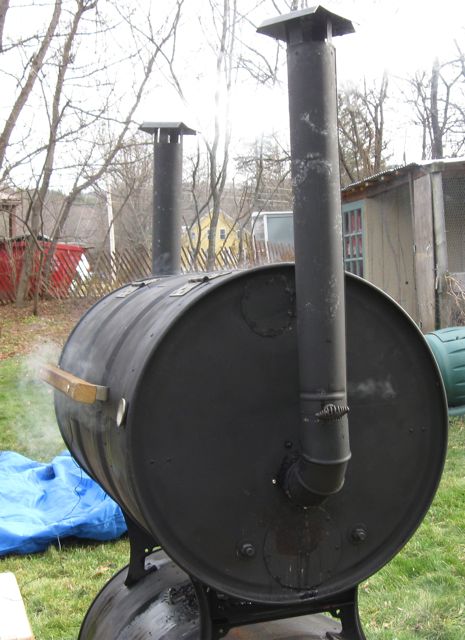
My Homemade Meat Smoker

This is another post in a similar vein to the one before it. That is to say that it is a post about creativity. In this case, the creativity of myself and some friends in building a meat smoker. In case you missed the previous post and are too lazy to go back and look at it, the summary is that we are creative because God is creative and we are made in his image. I thank God for his creativity not only in my own case, but especially for the creativity of the man who came up with the supremely God-like idea to smoke meat (and I think that the odds are pretty good that it was a man).

A while back (a couple of years ago now) some culinarily adept grad student friends of mine and I came up with a somewhat harebrained scheme to build our own meat smoker. The basic idea is that you take a metal trash can (new, not used), put a hot plate in the bottom with a box of hardwood chips on it (soaked in water so they last longer and steam as well as smoke), put some meat near the top, and let it cook for several hours (ideally somewhere around 215-225 degrees Fahrenheit). I think it's just about the best way to cook meat. After building it, I sort of inherited the smoker and have used it periodically to cook ribs, pork loin, and several turkeys.

Of course, the details are a little more complicated than the simple picture painted above and over the course of the years, there have been some necessary adjustments to the smoker. Here are two pictures of the smoker (top on and top off):


Some of the first things to notice are the temperature gauge on the top (you need to know how hot it is in there - there is a second thermometer on the side), the door at the bottom (for adding more wood chips without lifting the lid and losing all the heat and smoke), and the wood blocks on the side (they are attached to the screws that hold the brackets that hold the grill grate - otherwise there would be screws sticking out of the side of the can). You can also see those brackets and the hot plate in the second image. There are two levels of brackets so that you can put a pan of liquid underneath to keep the meat from drying out or to put the meat closer to the heat if need be (the temperature is usually 20-30 degrees warmer at the lower brackets).

Warning: From here on out, the post may get a little technical. If you're not interested in the details of how to make a smoker or the technical challenges involved, you can just stop reading.

Now that we've lost all those boring, non-technical people, lets get to the interesting part. All of these things were in the original smoker design. The changes have all happened to the hot plate. It turns out that hot plates are not designed to be kept on for long periods of time in enclosed spaces. In fact they are designed to shut off if the temperature gets too hot (this is also how our hot plate was designed to regulate the heat). This is, in general a good thing. For a meat smoker, it is a bad thing. There were a couple of different variations we tried on bypassing the switch before settling on the simplest solution of directly wiring the plug to the hot plate with no other internal components whatsoever. This means that to "turn on" the smoker, you plug it in and to "turn it off" you unplug it. One of these days maybe I'll put in a switch. We also took out the body of the hot plate and mounted the heating element onto one of those metal wiring boxes (the kind that light switches are mounted on) just to make sure that there was no plastic to give off strange fumes.

This was more or less the way the smoker stayed for a couple years with one small, recurring problem: The wires just underneath the hot plate would periodically get brittle and break from the heat, effectively turning off the hot plate. If you really care to know, copper wire apparently has some oxygen in it (unless you pay a lot of money for pure copper wire). This oxygen when heated, reacts with the hydrogen in the air to form water which in turn evaporates into steam, leaving behind small holes and weakening the copper wire (end science lesson). It was never a huge deal, but whatever I would be cooking at the time would have to be finished in the oven. Now that I have time on my hands, I decided it was time to solve this problem. Being unemployed and on a tight budget, I also decided to solve the problem with whatever I had on hand.

So here is the task: I need to get the electrical current from outside the can to the hotplate without using copper wire (at least inside the can). My solution: use steel bars instead of wires and connect it using the wiring used for electric fences. Of course, this creates some other complications, mainly keeping the steel rods from blowing a circuit by touching the metal trash can (or each other). The only steel rods I had were rectangular (about 1" x 1/8"), so I had to cut away some of the metal box on which the heating element is mounted to give the rods a little room. I also ran them through a couple of pieces of wood (hardwood so that any smoke won't hurt) so that they wouldn't touch the bottom of the can or each other. On top of those pieces of wood, we placed a piece of glass to shield the bars from any dripping that might cause similar problems, (my father-in-law cut the glass for me). Here you can see some of that work (the slant of the glass is intentional to keep the drippings away from the steel):


On the left you can see through the door of the smoker to the hot plate and the pieces of wood and glass behind. You can also see the bar magnet in the foreground that keeps the door shut (it's sticking out of the right side of the doorway). On the right, you can see the underside of the hot plate where most of the electrical box has been cut away to make room for the steel bars.

Now that I've got it back together and working, there's a pork tenderloin in the fridge that's just asking to be smoked. We'll see how the new wiring holds up.

Monday, February 9, 2009

On Creativity

So it’s that time of year that we are still trying to remember not to write the previous year on the checks when we pay the bills and hoping that spring will be coming soon. It's also the time of year in Northern New England where the excesses alternately of salt and snow turn driving and parking into exercises in modern relativism: We are free to interpret lanes and parking spaces for ourselves as long as our interpretation doesn't directly contradict someone else's. And like modern relativism, it is just a practical implication of there being actual lanes and parking spots, which just happen to be difficult to see in the present circumstances. To see the underlying reality, it is only necessary to see what happens when trying to find your own lane where the snow plow hasn't defined it or where someone else is trying to find their own lane in the opposite direction.

Of course, it's not only a good time to make fun of modern relativism; it's also the time of year that my research appointment comes up for reevaluation. This time around, as I've known for a while, the project is coming to a close, which means I'm looking for a job. Of course, it's not the best time to be out of a job, but I'm not in charge of those decisions and not too worried about it. God has provided in the past and He will provide in the present and the future. As an interesting coincidence (if you believe in such nonsense), we just found out that we're done paying for our heat for the winter. Since we're on the budget plan that budgeted for oil to cost about five dollars a gallon for the year, we have enough money paid to the oil company that we're set until July. In fact, their note says "We only wish Wall Street and the investment bankers had been as smart as our customers." That makes me smile.

In the meantime, I have some time off to be a househusband and to be creative. In my first week off I made a light box for photography (shown below, think of it as a miniature photo studio), not only having fun with power tools, but spending almost no money (if I had had enough clip lights I wouldn't have spent anything). The next week I made some garlic-herb baguettes and it was the first time I'd made bread without the assistance of a bread machine (it turned out very well). Last week I made a rather experimental recipe of Apple Strawberry Nut Bread (which was delicious). I'll probably post more on some of those later, but I thought it was a good time to talk about creativity.


So why am I creative (or anyone else for that matter)? The short and glib answer (which is in this case also true) is that "God made me that way." In Exodus 35, the Bible speaks of a particular artist, saying "[God] has filled [this artist] with the Spirit of God, with skill, ability and knowledge in all kinds of crafts—to make artistic designs for work in gold, silver and bronze, to cut and set stones, to work in wood and to engage in all kinds of artistic craftsmanship." So I create because the Spirit of God is in me; because I was created in the image of God. To make my point a little clearer: I create because God is creative; the overflowing love of God has created a world in which his creativity is on display not only in the beauty of creation, but also in His ability to create creative beings.

To this end, our church just had an art display with pieces from a handful of artists in the congregation to celebrate the creativity that God has given us. I had some photos there and so did my lovely wife. We'll post pictures online soon, when I get around to making the page.

Monday, October 13, 2008

A Review of the Lord of the Rings movies

      I have to confess that I never thought that I'd actually be heckled for not updating my blog more frequently than I do. Apparently I was wrong; the world is indeed stranger and more fantastic than I ever imagined. Now that I've been heckled by a certain Tim, who shall remain nameless (no, not you, the other Tim). I have waited a couple months longer to update my blog to prove that such heckling is fruitless. You have to be firm with these Tims (not you either, the other other Tim). In keeping with my theme of procrastination, I am going to talk about a subject that is more than a little overdue: The Lord of the Rings movies. My wife and I recently watched through the extended versions of all three and all the special features as well (it has taken a couple months). Then I recently had a discussion with a friend who is a self-proclaimed Tolkien snob. On the heels of that, I want to put down where I think the movies went right and where they went wrong. In the end, I'll argue that when they went wrong, it was because they didn't understand Tolkien's Christian worldview.

      First, they did a great job on a number of fronts. Obviously, the special effects were amazing. The battle scenes (and the software written to do the big battle scenes) were phenomenal and all the orcs, fell beasts, oliphaunts, and the rest were marvels of modern digital wizardry. Similarly, the scenery, sets, and music were perfect and made amazing backdrops for the story. In terms of characters, they nailed several: Sam, Gollum, Boromir, Merry, Pippin, Gimli, etc. They made appropriate cuts in the story to fit it to film (Tom Bombadil, the burning of the shire) and interweaving of the many divergent storylines (especially in the last two movies). Watching the special features made me appreciate that in many ways the making of the movie was nearly as epic as the story itself.

      There is more to say about the things that they missed and I will do so by starting with how I think the writers misunderstand Tolkien's Christianity. First I think they miss the hand of divine providence and Christian unity and leadership. In the books, there are many providential moments. Merry & Pippin stumble upon the Ents who then take it upon themselves to attack Isengard; Frodo & Sam stumble across Faramir and gain help and counsel. There are also several points where "the good guys" band together to do what must be done. Aragorn leaves Rivendell with the sword of Isildur with the intention of eventually claiming his rightful throne in Gondor. The people of Rohan hole up at Helm's Deep to weather the onslaught of Saruman upon the advice of Gandalf; Faramir sends Frodo & Sam on their way with no desire for the one ring; Gondor lights the beacons and Rohan comes to their aid; Frodo & Sam never lose sight of their agreement that the ring needs to be destroyed.

      Instead of emphasizing the providence of circumstances, the fellowship seems to be fighting the circumstances to bring about the desired result. Merry & Pippin have to trick the ents into attacking Isengard and Frodo & Sam have to convince Faramir that the ring needs to be destroyed. These instances rob the ents of their wisdom. Merry is right in his assessment that the ents are part of the world and that being neutral is being on the side of the enemy. It also makes Faramir turn a second Boromir who can't see the truth of the deception of the ring. There are those over whom the temptation of power has no influence and Faramir should be one of those.

      Similarly, there is much discord about what to do and much questioning of leadership. Aragorn runs away from his claim to the throne of Gondor; Gandalf, Aragon, and the rest try to talk Theoden out of taking refuge at Helm's Deep and then grumble about the choice constantly in front of Theoden's men; Faramir uncharacteristically lusts after the power of the ring; Pippin has to light the beacons behind Denethor's back; and Aragorn has to convince Theoden to answer the beacons; Frodo sends Sam away childishly.

      Most of the time, this is done for suspense, but at what cost? Aragorn becomes a man who has commitment issues; Gandalf becomes a bumbling advisor without insight (Helm's Deep) or respect for authority (Theoden & Denethor); Aragorn, Gimli, & Legolas uncharacteristically undermine the authority of Theoden before a major battle; Theoden becomes a stubborn, crotchety old man; and Frodo becomes a whiny addict without perspective. Gandalf openly mocks Pippin's selfless oath to Denethor, ruining the beauty and innocence of the act and then shows no restraint in arguing with Denethor. In general, few of the characters are able to keep the big picture in mind that there is an evil that needs to be fought that is bigger than any one person's ego.

      Aside from those big thematic issues, I also wanted to mention a problem in a very particular scene: The Mouth of Sauron. Aragorn's response to the taunts of the mouth of Sauron in the movie is to kill him in cold blood. Now Aragorn is no different than Sauron himself who kills because he is displeased. They went through all that earlier with Frodo and Gollum and now they carelessly miss their own point here with Aragorn. The bad guys are bad for the means they use to get to their desired ends as well as for the ends themselves (perhaps even primarily so). My friend the Tolkien snob also argued that they missed the wisdom of Gandalf and the others in seeing that Sauron must not have the ring, even if he did have Frodo since he had not yet taken over the world. I am not convinced that they didn't realize this in the movie, but they certainly didn't make a point of it.

      There are more issues, but these are the biggest in my mind and very Christian in their nature. God doesn't call the equipped, He equips the called; sometimes Christian action means acting taking up the authority that God has given you and sometimes it means submitting to the authority of another person, but it never means grumbling about it or running away from it; contemplation and good counsel lead to wise action; stick to your principles because they may be able to kill you, but only you can lose your soul. As Dr. John Hannah recently said, "I used to think that bad people did bad things for bad reasons, but now I realize that good people do bad things for very good reasons."